

Associated Retina Specialist offers a noninvasive light-based treatment option for eligible patients with dry age-related macular degeneration — available at Associated Retina Specialist.
AMD is one of the leading causes of vision impairment among our older population. If you or someone you love has been diagnosed with dry AMD, understanding the condition and the available treatments is an important step toward protecting your vision.
Treatment options for dry AMD used to be limited primarily to monitoring, lifestyle recommendations, nutritional supplements for certain patients, and management of associated risk factors.
Valeda Light Therapy offers a new approach, expanding the options available to certain patients, especially right here in busy NYC. This is an FDA-authorized treatment that uses specific wavelengths of light to improve visual acuity in patients with AMD. It’s a noninvasive technology called *photobiomodulation* (PBM) which does not require injections or surgery.
At Associated Retina Specialist we evaluate each patient’s retinal health, disease stage, and vision to determine whether Valeda may be an appropriate treatment option.
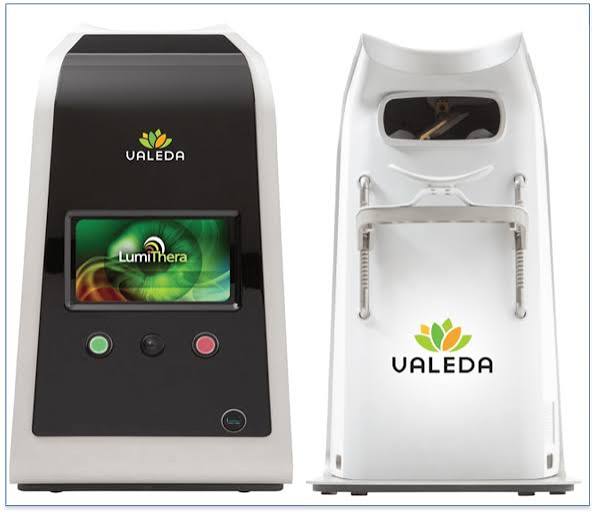
What Is Valeda Light Therapy?
This technology is a new treatment that uses carefully controlled wavelengths of light to influence cellular activity within the retina.
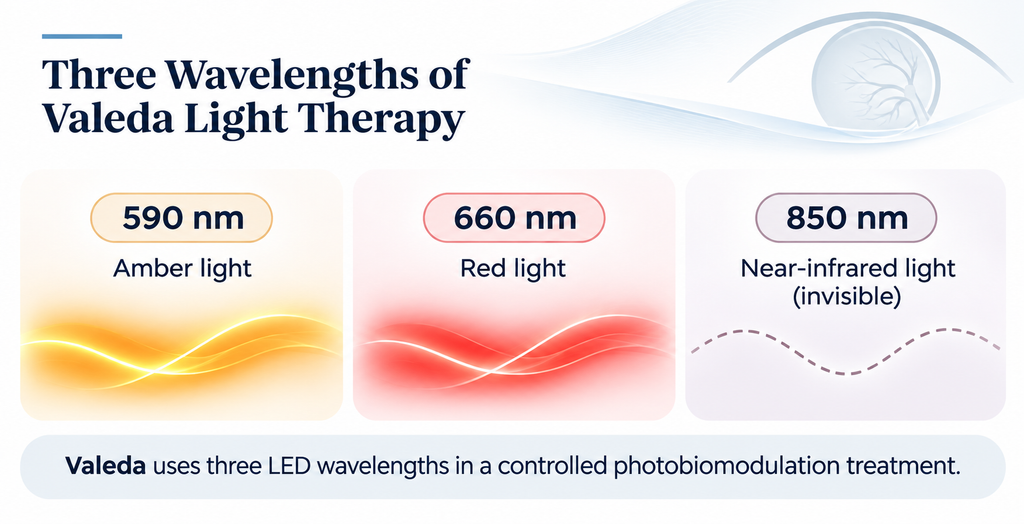
Developed by LumiThera, the Valeda Light Delivery System delivers light at three wavelengths:
- 590 nanometers: Yellow light
- 660 nanometers: Red light
- 850 nanometers: Near-infrared light
These wavelengths are used in a process known as photobiomodulation.
Unlike surgical procedures or intravitreal injections, Valeda delivers light without making an incision or introducing medication into the eye.
The treatment is designed to improve visual function in patients who meet specific clinical eligibility requirements.
Is Valeda FDA-Authorized?
In November 2024, the U.S. Food and Drug Administration granted De Novo marketing authorization for the Valeda Light Delivery System.
This authorization established a new medical-device classification for light-based treatment of dry age-related macular degeneration.
The FDA-authorized indication is specifically for patients with dry AMD who have best-corrected visual acuity between 20/32 and 20/70 and certain qualifying retinal findings.
Not every patient with dry AMD is eligible.
A comprehensive examination by one of our doctors at Associated Retina Specialist is the best way to determine whether Valeda is appropriate for your situation.
Understanding Dry Age-Related Macular Degeneration
Age-related macular degeneration affects the macula, a small but critically important area near the center of the retina.
The macula is responsible for the sharp central vision needed to read, recognize faces, drive vehicles, and see fine details. Some symptoms include blurry or reduced central vision, difficulty reading small print like in physical books, or the newspaper. You may find the need for brighter lighting because it’s difficult to adapting to dim environments as easily as you could when you were younger.
When the macula becomes damaged, these activities can become increasingly difficult.
What Causes Dry Macular Degeneration?
Dry AMD develops through a combination of age-related changes, genetic susceptibility, environmental influences, and cellular processes affecting the retina.
One common characteristic is the accumulation of deposits called *drusen* beneath the retina.
Over time, changes involving the retinal pigment epithelium and photoreceptor cells can interfere with normal visual function.
Risk factors include increasing age, family history, smoking, and certain cardiovascular or lifestyle factors.
Dry AMD may develop gradually, and some patients experience few noticeable symptoms in its earlier stages.
Dry AMD vs. Wet AMD
Dry AMD is the more common form of age-related macular degeneration.
Wet AMD occurs when abnormal blood vessels develop beneath the retina and leak fluid or blood, potentially causing rapid vision changes.
These two forms of AMD require different approaches to treatment. Valeda is authorized for certain patients with dry AMD. It is not a replacement for treatments used to manage wet AMD. Your Associated Retina Specialist can determine which form of AMD you have and the best treatment for your condition.
How Does Valeda Photobiomodulation Work?
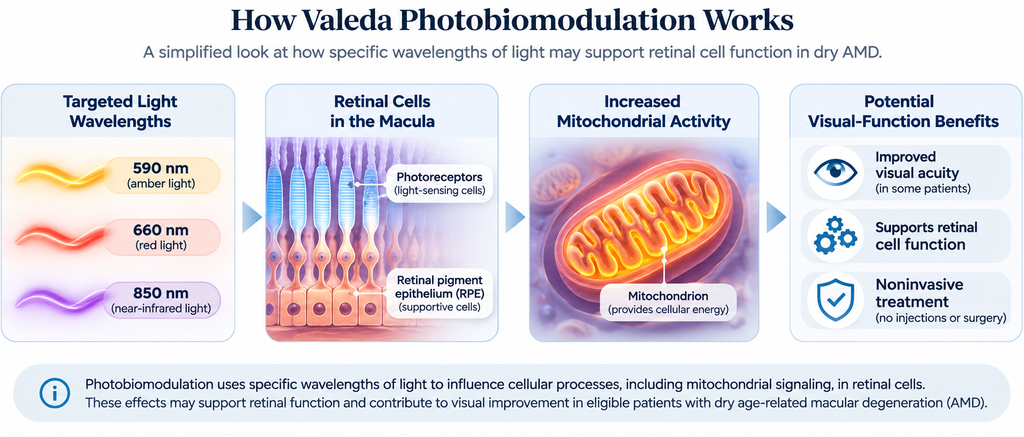
Photobiomodulation uses specific wavelengths of light to influence biological processes within cells. One area of research focuses on your mitochondria, the structures responsible for producing much of the energy your cells need to function.
The retina is a highly active tissue with substantial energy requirements.
Researchers believe photobiomodulation may influence mitochondrial signaling and other cellular processes associated with retinal function. The three wavelengths used by Valeda are intended to produce complementary biological effects.
However, the precise mechanisms responsible for the clinical improvements observed in Valeda studies have not been fully established.
Photoreceptor cells within the retina help convert light into electrical signals that the brain interprets as vision. These cells rely on surrounding retinal structures and normal cellular processes to function.
As your AMD condition progresses, changes in the retinal environment can interfere with these processes. Valeda is designed to support improvements in visual function through light-based cellular effects rather than through surgery or injected medication.
Who Is a Candidate for Valeda Treatment?
When a patient comes into our NYC office, we run tests to determine your eligibility for Valeda during our consultation. Valeda is intended for patients with dry AMD who have best-corrected visual acuity between 20/32 and 20/70, and meet specified retinal criteria.
These criteria include the presence of at least three medium drusen, large drusen, or noncentral geographic atrophy. We are looking for patients to be free of neovascular maculopathy and center-involving geographic atrophy under the authorized indication.
Your evaluation may include:
- Medical and ophthalmic history
- Best-corrected visual acuity testing
- Dilated retinal examination
- Optical coherence tomography (OCT)
- Retinal photography or other imaging when indicated
- Assessment of drusen and retinal atrophy
- Evaluation for other retinal diseases
The Retina specialist will consider your individual findings and whether treatment aligns with the FDA-authorized indication.
Who May Not Be Eligible?
Patients whose retinal findings or vision fall outside the authorized indication may not be candidates. Patients with wet AMD or center-involving geographic atrophy do not meet the specific retinal criteria described in the FDA authorization.
Other medical or ocular factors may also affect suitability. The final decision is determined by the clinical assessment of the retina specialist.
What Does Clinical Research Say About Valeda?
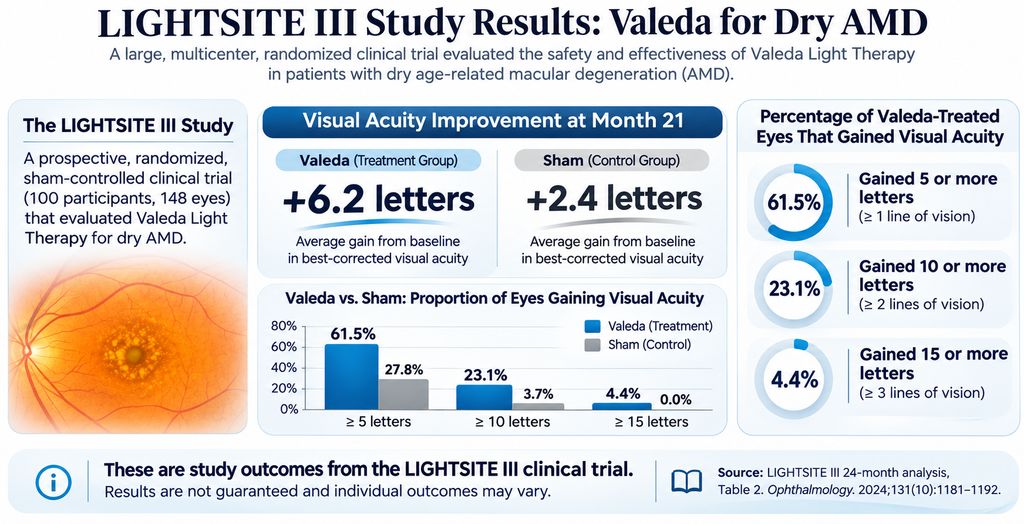
Valeda has been studied in multiple clinical trials. One of the most important studies is from LIGHTSITE III, a randomized, double-masked, sham-controlled clinical trial.
The study enrolled 100 participants, representing 148 eyes with dry AMD. Researchers evaluated visual acuity, retinal changes, safety, and other measures over approximately two years.
In the published 24-month analysis, eyes receiving photobiomodulation showed an average improvement of 6.2 letters on a standardized visual acuity chart at month 21.
The study met its prespecified primary visual-acuity endpoint, demonstrating a statistically significant difference between treatment groups.
At month 21, among PBM-treated eyes:
- 61.5% gained at least five letters.
- 23.1% gained at least ten letters.
- 4.4% gained at least fifteen letters.
These results describe outcomes in the study population. They do not predict how much improvement an individual patient will experience.
In standardized ETDRS visual-acuity testing, five letters correspond approximately to one line on the chart. A noticeable improvement in chart performance may be meaningful, but it does not necessarily translate into the same functional benefit for every patient.
The LIGHTSITE III investigators also reported a lower incidence of newly developed geographic atrophy in the photobiomodulation group than in the sham group at 24 months. This was a secondary finding and should not be interpreted as proof that Valeda prevents geographic atrophy or eliminates the risk of AMD progression.
What Happens During a Valeda Treatment Session?
Valeda treatment is administered in a clinical setting here in our NYC offices using the specialized Light Delivery System. Because treatment is noninvasive, it does not require injections or surgical incisions.
Step 1: Comprehensive Retinal Evaluation
Before treatment, your Associated Retina Specialist evaluates your vision, retinal condition, and medical history to determine whether you are an appropriate candidate.
Step 2: Treatment Planning
If Valeda is recommended, our office will explain the treatment schedule, expected visits, and follow-up requirements.
Step 3: Light-Based Treatment
During the procedure, the device delivers controlled wavelengths of light according to the prescribed protocol.
Our care team will provide instructions on positioning and what to expect during the session.
Step 4: Follow-Up and Monitoring
Your retina specialist may monitor your visual acuity and retinal condition over time to assess changes and determine whether additional treatment is appropriate.
In LIGHTSITE III, each treatment series consisted of nine sessions administered over approximately three to five weeks. Treatment series were repeated approximately every four months during the study.
The schedule offered by Associated Retina Specialist should be confirmed directly with the office.
Is Valeda Light Therapy Safe?
Valeda has demonstrated a generally favorable safety profile in the studied patient population. The LIGHTSITE III investigators reported no signs of phototoxicity associated with treatment.
However, favorable trial findings do not mean that the procedure is risk-free or suitable for everyone. Our retina specialist will discuss potential risks, contraindications, precautions, and treatment expectations with you.
Treatment must follow the applicable device labeling and clinical guidance.
How Does Valeda Compare With Other Dry AMD Treatments?
Management of dry AMD depends on disease stage, retinal findings, and individual risk factors. Different approaches address different aspects of your condition.
Regular retinal examinations help our retina specialists monitor your AMD progression. Smoking cessation, management of relevant health conditions, and appropriate lifestyle measures may form part of your individualized management plan.
Certain intravitreal treatments are available for geographic atrophy secondary to AMD. These treatments are intended to slow the growth of atrophic lesions rather than restore vision. They have different indications, mechanisms, and treatment requirements from Valeda.
How Much Does Valeda Light Therapy Cost in NYC?
Your treatment costs may vary depending on the recommended protocol and expected number of visits. We’ll help you clarify any insurance benefits or out-of-pocket costs before starting treatment.
Insurance coverage for Valeda should not be assumed.
Associated Retina Specialist can provide information about its current payment arrangements and help patients understand the next steps for obtaining a treatment estimate.
Why Choose Associated Retina Specialist for Valeda Treatment?
Associated Retina Specialist focuses on the diagnosis, evaluation, and management of diseases affecting the retina and macula. For our patients considering Valeda, an accurate diagnosis and careful assessment of treatment eligibility are essential.
Our practice provides retinal evaluation and helps patients understand their treatment options based on their individual findings. Valeda is one option that may be considered for eligible patients with dry AMD.
Our goal is to provide informed, individualized care while helping patients understand both the potential benefits and limitations of treatment.
Valeda Light Therapy in Manhattan, NYC
Associated Retina Specialist offers Valeda Light Therapy for eligible patients at its Manhattan practice.
Associated Retina Specialist, PLLC
20 West 13th Street
New York, NY 10011
Phone: 212-604-9800
Website: retinanewyork.com
Patients from Manhattan and throughout the New York City area can contact the office to request a retinal evaluation and learn more about whether Valeda photobiomodulation treatment is right for you.
Frequently Asked Questions About Valeda Light Therapy
Is Valeda Light Therapy FDA-approved?
Valeda received FDA De Novo marketing authorization in November 2024 for a specific population of patients with dry age-related macular degeneration.
Can Valeda cure dry macular degeneration?
No. Valeda is not a cure for AMD. Clinical studies have demonstrated improvements in visual acuity in some eligible patients, but results vary.
Can Valeda restore lost vision?
Some study participants experienced measurable improvements in visual acuity. However, treatment cannot be expected to reverse all retinal damage or restore normal vision.
Is Valeda treatment painful?
Valeda is noninvasive and does not require injections or surgical incisions. Your treating retina specialist can explain what sensations or discomfort may occur.
How long does Valeda treatment take?
The total treatment schedule involves multiple visits. The duration of individual sessions and the practice’s treatment protocol are different for each patient. Treatment plans will be confirmed with the retina specialist in the office.
How many Valeda treatments will I need?
In LIGHTSITE III, patients received nine-session treatment series, repeated approximately every four months. Your specialist will explain the recommended schedule for your circumstances.
Is Valeda safe for both eyes?
Eligibility and treatment decisions are made separately based on each eye’s findings. Your retina specialist will determine whether treatment of one or both eyes is appropriate.
Can Valeda prevent macular degeneration from progressing?
The clinical research includes encouraging findings, but Valeda should not be described as preventing AMD progression. Its FDA-authorized indication concerns improvement in visual acuity in eligible patients.
Is Valeda the same as red light therapy?
Valeda is a specific prescription medical device using a controlled combination of wavelengths and treatment parameters. It should not be equated with consumer red-light devices.
Can I use a home red-light device instead?
Consumer light devices are not substitutes for Valeda treatment. Patients should not attempt to replicate a prescription retinal treatment using an unapproved home device.
Is Valeda appropriate for wet AMD?
Valeda’s authorized indication concerns certain patients with dry AMD. Wet AMD typically requires different treatment approaches.
Does insurance cover Valeda treatment?
Coverage depends on the insurer and policy. Contact the office for current information about treatment costs and any applicable benefits.
How do I know whether I’m eligible for Valeda?
A retina specialist must evaluate your vision, retinal imaging, and disease characteristics to determine whether you meet the appropriate clinical criteria.
Where can I receive Valeda Light Therapy in NYC?
Associated Retina Specialist offers Valeda treatment at its Manhattan practice. Contact the office to request an evaluation.
Take the Next Step Toward Better Vision
If you have been diagnosed with dry age-related macular degeneration, you may have questions about available treatments and whether Valeda could be appropriate for your condition. The first step is a comprehensive retinal evaluation.
At Associated Retina Specialist, our team can review your diagnosis, assess your eligibility, and discuss treatment options based on your individual retinal health.
Call 212-604-9800 or visit retinanewyork.com to request an appointment.
*Medical disclaimer: This article is for educational purposes only and does not replace individualized medical advice, diagnosis, or treatment. Treatment eligibility, potential benefits, risks, and expected outcomes must be evaluated by a qualified eye care professional.*